
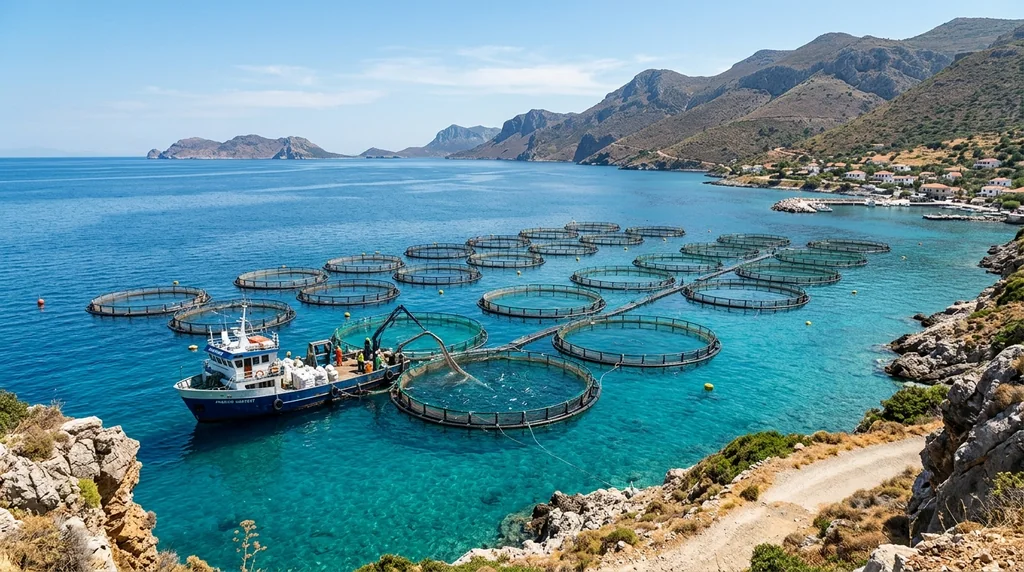
Across the Mediterranean basin, diversification away from the traditional duopoly of European Sea Bass (*Dicentrarchus labrax*) and Gilthead Sea Bream (*Sparus aurata*) is a major commercial priority. Among candidate finfish species, the Sciaenidae drum family commands intense market interest due to superior growth potential, white flaked flesh, and outstanding culinary value. However, international trade and technical literature are frequently clouded by taxonomic confusion between two distinct sciaenid species: **Brown Meagre (*Sciaena umbra*) and Meagre (*Argyrosomus regius*)**.
For commercial seafood buyers, aquaculture producers, and culinary directors, understanding the biological boundaries, culture requirements, and sensory attributes of these two species is essential for regulatory compliance and market positioning.
Taxonomic Disambiguation: *Sciaena umbra* vs *Argyrosomus regius*
Under EU catch and aquaculture labelling regulations (Regulation (EU) No 1379/2013, Article 35) and commercial registers (such as Spain's BOE and Germany's BLE), commercial designations are legally tied to Latin binomials. Misidentifying one species for the other constitutes a regulatory failure.
| Biological & Commercial Metric | Brown Meagre (*Sciaena umbra*) | Meagre (*Argyrosomus regius*) |
|---|---|---|
| Common Trade Names | Brown meagre, Corvallo, Umbrine, Eşkina, Gölge balığı | Meagre, Corvina, Adlerfisch, Umberfisch, Sarıağız, Kaya levreği |
| Adult Body Morphology | High arched back, dark bronze-black/golden body, yellow pelvic/anal fins | Elongated spindle profile, gleaming silvery-grey flank, bright yellow-orange mouth interior |
| Maximum Wild Size | 50 – 70 cm; rarely exceeds 4.0 kg | Up to 200 cm; wild specimens exceed 40 – 50 kg |
| Commercial Harvest Size | 400 g – 1.0 kg (Portion size niche) | 1.5 kg – 5.0+ kg (Large whole fish & filleting steaks) |
| Aquaculture Maturity | Slow-to-moderate grower; primarily boutique land-based / coastal trial scale | Fast grower; dominant industrial sea-cage commercial aquaculture species |
| Commercial Designation | Listed as *Corvallo* / *Eşkina*; distinct SKU | Listed as *Meagre* / *Corvina* / *Sarıağız* in our commercial seafood catalogue |
While *Sciaena umbra* thrives around rocky reefs and littoral caves—making it prized by artisanal fisheries and selective coastal aquaculture projects—*Argyrosomus regius* represents the true heavy-weight commercial species farmed extensively across Turkey, Greece, Spain, and France. In our commercial export line, explore the detailed specifications of Meagre (Argyrosomus regius).
Mediterranean Grow-Out Dynamics & Water Chemistry
Commercial grow-out of *Argyrosomus regius* is conducted primarily in deep offshore gravity floating net pens and semi-closed coastal concessions. The species exhibits extraordinary biological vigor:
Specific Growth Rate (SGR) and Feed Conversion
- Growth Velocity: Meagre reaches a commercial weight of 1.5 kg to 2.5 kg in 18 to 24 months from a 5-gram fingerling, growing substantially faster than European Sea Bass under identical thermal conditions.
- Feed Conversion Ratio (FCR): In well-managed cage arrays using automated feeding systems and acoustic sensor arrays, commercial FCR consistently ranges between 1.25 and 1.45.
- Protein & Lipid Requirements: Juveniles require high dietary protein (45–48%) with moderate lipid levels (14–17%). Unlike sea bass, meagre possesses limited lipogenic capacity in muscle tissue, partitioning excess dietary energy into perivisceral fat rather than intramuscular marbling.
Environmental Tolerances
- Thermal Window: Optimal feeding and conversion occur between 18 °C and 26 °C. Meagre ceases active feeding below 12 °C and exhibits metabolic lethargy beneath 8 °C. Winter management requires sheltered cage sites or thermal stabilization in coastal lagoons.
- Salinity Flexibility: Euryhaline capacity is exceptional; meagre thrives across marine salinities (35–38 ppt) down to brackish estuaries (10–15 ppt), making it adaptable to estuarine earthen ponds.
- Dissolved Oxygen: Highly sensitive to hypoxia. Sea-cage sites must maintain DO levels above 5.5 mg/L; ambient flow velocities between 15 and 45 cm/s ensure adequate water exchange and gill flush.
Nutritional Flesh Profile & Biochemical Composition
The flesh of meagre is characterized by firm, dense white muscle blocks that yield clean, glistening fillets with exceptional moisture retention upon cooking.
Proximate Muscle Analysis (per 100g raw fillet)
| Nutritional Parameter | Farmed Meagre (*A. regius*) | Farmed Sea Bass (*D. labrax*) | Farmed Sea Bream (*S. aurata*) |
|---|---|---|---|
| Crude Protein | 20.5 – 22.0 g | 19.0 – 20.5 g | 18.5 – 20.0 g |
| Crude Fat / Lipids | 1.5 – 3.8 g | 6.5 – 9.0 g | 7.5 – 10.5 g |
| Moisture | 74.5 – 76.5 g | 70.0 – 72.5 g | 68.5 – 71.0 g |
| Total Mineral Ash | 1.1 – 1.3 g | 1.1 – 1.2 g | 1.1 – 1.3 g |
| Caloric Value | ~95 – 115 kcal | ~135 – 165 kcal | ~145 – 175 kcal |
| Atherogenic Index | 0.32 (Very low) | 0.45 – 0.52 | 0.48 – 0.55 |
Because meagre deposits very little intramuscular fat, it represents one of the leanest premium marine whitefish available from Mediterranean aquaculture. The fatty acid profile remains rich in long-chain polyunsaturated fatty acids (PUFA), delivering an EPA + DHA content of approximately 450 to 650 mg per 100 g portion.
Culinary Processing, Fillet Yield & Gastronomic Applications
Commercial processors and hospitality buyers prize meagre for superior dress-out recovery compared to traditional spiny finfish:
Fillet Recovery Dynamics
- Whole Ungutted to Head-On Gutted (HOG): 88% – 91% yield.
- Skin-On, Trim-D Fillet Yield: 42% – 46% (compared to 34–38% in European Sea Bass and 31–35% in Sea Bream).
- Steak / Darne Yield: 58% – 64% from large 3+ kg specimens.
Culinary Performance in Commercial Kitchens
The thick myotome flake structure gives meagre remarkable versatility across raw and high-heat cooking techniques: - Raw Preparations (Crudo, Ceviche, Sashimi): When harvested with immediate ice-slurry hypothermia and held under 0 °C to 2 °C cold chain, the muscle exhibits a firm, springy texture with pristine translucence. It absorbs citrus and marinades without turning mealy. - Roasting & Grilling: The low fat content is compensated by dense collagen between muscle myomeres, preventing fillet disintegration on high-heat charcoal grills or combi-steamers.
To review our complete fresh and frozen logistics portfolio, consult our global seafood export solutions or contact our commercial sales desk.
Export Packaging, Cold Chain & Veterinary Standards
Transporting fresh and IQF frozen meagre requires rigorous cold-chain integrity: 1. Bleeding & Hypothermic Slurry Chilling: Immediately post-crowding, fish are transferred into a zero-degree seawater ice slurry ($0 \text{ °C to } -1 \text{ °C}$), ensuring complete muscle relaxation, preventing lactic acid buildup, and delaying rigor mortis onset. 2. Packaging: Packed in heavy-duty expanded polystyrene (EPS) boxes with perforated interior false bottoms and food-grade gel ice packs. Whole fish are arranged belly-down in alternating orientations. 3. Veterinary Certification: Every commercial export consignment is backed by official EU TRACES veterinary certificates, Certificate of Origin, and complete cold-chain temperature logger telemetry.
Aquaculture Terminology & Technical Definitions
- Atherogenic Index: A nutritional metric indicating the cardioprotective quality of dietary fat; lower values denote healthier lipid compositions with low plaque-forming potential.
- Euryhaline: The biological capacity to survive and osmoregulate across a wide gradient of water salinities.
- Fillet Yield (Trim-D): The percentage of usable boneless, belly-trimmed, tail-squared muscle meat recovered from whole ungutted fish.
- Hypothermic Slurry Chilling: The process of rapid temperature reduction using a liquid mixture of ice flakes and seawater to reach 0 °C within minutes of harvest.
- Myotome: The individual segmented muscle blocks that constitute fish fillets; broad myotomes yield the desirable flaking texture in cooked whitefish.
- Specific Growth Rate (SGR): The daily percentage weight gain calculated exponentially: $\text{SGR} = 100 \times [\ln(W_2) - \ln(W_1)] / t$. For further formulas, explore our aquaculture terminology glossary.
Scientific References
- Monfort, M. C. (2010). Present market situation and prospects of meagre (*Argyrosomus regius*) in the Mediterranean. Studies and Reviews. General Fisheries Commission for the Mediterranean. No. 89. FAO, Rome.
- Fountoulaki, E., Alexis, M., & Nengas, I. (2006). Fat and protein requirements of meagre (*Argyrosomus regius*) juveniles. Aquaculture Nutrition, 12(6), 405-416.
- Poli, B. M., Parisi, G., Zampacavallo, G., Iurzan, F., Mecatti, M., Lupi, P., & Bonelli, A. (2003). Preliminary results on quality and quality changes in farmed meagre (*Argyrosomus regius*) after slaughtering. Aquaculture International, 11(1), 77-86.
- Piccolo, G., Bovera, F., De Salvo, F., Ermilio, R., & Nizza, A. (2008). Effect of dietary protein levels on growth performance and fillet quality of meagre (*Argyrosomus regius*). Italian Journal of Animal Science, 7(3), 329-338.
- Grigorakis, K., Fountoulaki, E., Vasilaki, A., Lemonida, I., & Alexis, M. N. (2011). Lipid quality and filleting yield of farmed meagre (*Argyrosomus regius*). International Journal of Food Science & Technology, 46(4), 711-716.

